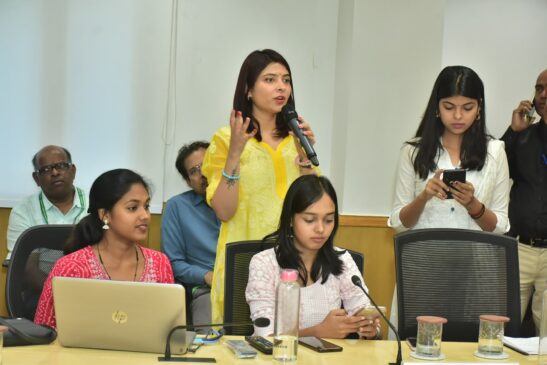
At BrilliantRead Media, it is our constant endeavour to identify and share inspiring stories of entrepreneurs and changemakers who are making a meaningful difference in society. As part of this endeavour, we are delighted to feature Tanvi Singh, Founder of Leap of Love Foundation, whose journey reflects a deep commitment to mental health, social impact, and inclusive community development.
With a background in science and AI research in Germany, Tanvi’s professional journey has evolved across diverse fields, ultimately leading her to establish Leap of Love Foundation in 2022. Through its work in mental health awareness, therapeutic support, education, child safeguarding, disability inclusion, and community wellbeing, the foundation strives to make essential support more accessible and build communities where individuals are treated with dignity, empathy, and respect.
Combining analytical thinking with a people-centric approach, Tanvi is passionate about addressing the systemic barriers that prevent individuals and families from accessing the support they need. Her vision is to build sustainable, research-informed models of care that promote mental wellbeing, strengthen inclusion, and create lasting social impact.
Let’s learn more about her journey, vision, and insights in our exclusive interview with Tanvi Singh!
Excerpts from our exclusive interview with Tanvi:
From AI research in Germany to building a social-impact organisation in India, what inspired your transition from technology to working more closely with people and communities?
I wouldn’t say there was one defining moment. It was more of a gradual shift in how I understood the kind of impact I wanted to create. My background in science and AI research taught me to approach problems analytically, ask questions, and look for solutions. Over time, however, I became increasingly interested in the human side of the problems we were trying to solve.
I began asking questions such as: What shapes people’s behaviour? Why do some individuals have access to opportunities while others struggle to access even basic support? And why do systems designed to help people sometimes fail to reach those who need them most?
Eventually, I realised that I wanted to work closer to these realities. My journey took me through different worlds, including branding, startups, and eventually founding Leap of Love Foundation. Each experience taught me something different about people, systems, and the process of turning an idea into something meaningful.
I don’t see this transition as leaving science behind. I still value research, evidence, and analytical thinking. I have simply found a different application for them. Today, I want to bring these approaches together to understand human needs, identify gaps, and build solutions that make a tangible difference in people’s lives.
Leap of Love Foundation focuses on making mental health support accessible and building inclusive communities. What gap inspired you to establish the foundation in 2022, and how has your vision evolved since then?
When I started Leap of Love Foundation in 2022, I was increasingly aware that people’s needs rarely exist in isolation. A child may need educational support but also emotional safety. A person may need mental healthcare but be unable to afford it. A family may need financial assistance, guidance, and access to community resources simultaneously.
Yet support is often fragmented. We tend to address one problem at a time without considering the circumstances surrounding it. This shaped our vision of building an ecosystem of care at Leap of Love Foundation.
Our work spans mental health awareness and therapeutic support, financial assistance, education, child safeguarding, disability inclusion, and community wellbeing. The idea is to recognise people in the entirety of their circumstances rather than reducing them to a single need.
Since 2022, my understanding of social impact has also evolved. I have realised that delivering programmes is only one part of the work. We must understand whether interventions are effective, identify barriers to accessing support, and build models that can be sustained over time.
Going forward, I want us to strengthen our research, develop evidence-informed interventions, and build partnerships that help make mental healthcare and other essential support more accessible. Our vision is not simply to help more people. It is to contribute to a system in which fewer people are excluded from care in the first place.
Your work spans children, neurodivergent individuals, women, and elderly communities. What is one important lesson from your field experience that has changed your understanding of resilience and inclusion?
One of the most important lessons I have learnt through our work with children and persons with disabilities is that what we perceive as an individual’s limitation is sometimes a limitation of the environment we have created around them.
We often expect people to communicate, learn, behave, and participate in particular ways. When they cannot meet those expectations, we tend to focus on what they need to change. But we don’t always ask whether the environment itself needs to change.
That question has significantly influenced how I think about inclusion. Inclusion is not simply about bringing someone into a classroom, a programme, or a community space. It is about whether they can participate meaningfully, communicate their needs, exercise autonomy, and be treated with dignity.
My work has also changed how I understand resilience. We often celebrate people for overcoming adversity, but we can become so focused on their strength that we overlook the barriers they should never have had to face alone.
I don’t believe resilience should become an excuse for society to withhold support. We should admire people’s ability to navigate difficult circumstances while also working to make those circumstances less difficult.
That is what I keep coming back to: before asking someone to adapt, we should examine what we can change around them.
Mental health conversations often begin with awareness, but meaningful change requires consistent support. What are some of the biggest misconceptions about mental health in India, and what needs to change?
One of the biggest misconceptions is that mental health struggles reflect weakness, a lack of discipline, or an inability to cope with life’s challenges. Another is that awareness alone is enough.
We can tell someone to seek therapy, but what happens when they cannot afford it? What happens when their family dismisses their concerns, when services are unavailable in their community, or when they do not know where to turn?
For many people, the problem is not simply stigma. It is also affordability, availability, information, and access.
I believe we need change at several levels. Families need to learn to listen without immediately judging or minimising someone’s experience. Schools and colleges need to move beyond occasional awareness sessions towards sustained emotional education, early identification, and appropriate referral systems. Communities need accessible information and affordable pathways to care.
We also need stronger research into the mental health needs of underserved populations and the effectiveness of different forms of support. Without understanding people’s lived realities, we risk designing interventions that look good on paper but do not work for the people who need them.
Most importantly, we must recognise that mental health is connected to the conditions in which people live. Financial insecurity, social isolation, exclusion, and a lack of support can all affect wellbeing.
Awareness opens the conversation. Accessible, affordable, and consistent support is what allows that conversation to lead to meaningful change.
Building a social-impact organisation requires balancing empathy with execution, particularly when resources are limited. What have been your biggest challenges in growing Leap of Love Foundation, and how have you built a committed team?
One of the biggest challenges has been trying to meet substantial needs with limited resources while building an organisation that can sustain its work over time. In social impact, the need is almost always greater than the resources available. There are communities we want to reach, programmes we want to strengthen, and people who need support. But every initiative requires funding, people, partnerships, and systems that can deliver consistently.
Another challenge is balancing empathy with execution. Caring deeply about a problem is important, but it does not automatically translate into an effective solution. We have to plan, follow through, assess what is working, and be willing to adapt when something isn’t.
I have learnt that a mission cannot depend on one person’s passion alone. It needs a team that understands why the work matters, has clarity about its responsibilities, and feels supported in carrying it forward.
At Leap of Love Foundation, our team, volunteers, interns, and partners bring different skills and perspectives to the work. Their contributions are essential to turning our intentions into action.
I have also learnt to think beyond immediate visibility. A successful event or a large number of beneficiaries can be encouraging, but we must also ask what changes as a result of our work and whether that change can be sustained.
For me, building the organisation is not just about growing its reach. It is about developing the capacity, credibility, partnerships, and evidence needed to make our work more effective over the long term.
What does genuine inclusion look like beyond awareness campaigns, and how can schools, workplaces, families, and society create environments where people feel understood rather than pressured to fit in?
Genuine inclusion begins when we stop expecting everyone to fit into environments that were designed around only some people’s needs.
In schools, this means recognising that children learn, communicate, and participate differently. In workplaces, it means creating conditions where people can contribute meaningfully without having to constantly justify their needs. In families, it means listening to people as individuals rather than assuming that care gives us the right to decide what is best for them. Across society, it means recognising that inclusion must be accompanied by access, autonomy, and dignity.
Through Leap of Love Foundation, our work includes child safeguarding, personal safety education, disability inclusion, and efforts to make communication and support more accessible. These initiatives have reinforced the importance of moving beyond awareness towards practical changes in how people interact with and support one another.
We also need to understand that inclusion is not about treating everyone identically. Sometimes, fairness requires different forms of support so that people have a meaningful opportunity to participate.
Most importantly, we must stop making people responsible for educating everyone around them about their own needs. Institutions and communities have a responsibility to learn, adapt, and create safer environments.
For me, inclusion is not just about making space for someone. It is about ensuring that they have the dignity, support, and freedom to participate on their own terms.
Looking ahead, what is your larger vision for Leap of Love Foundation over the next five years, and what lasting change would you like to see in India’s approach to mental health and community care?
Over the next five years, I want Leap of Love Foundation to evolve into a stronger, research-informed ecosystem of care that connects mental healthcare, education, financial assistance, disability inclusion, and community-based support.
One of my key priorities is making mental healthcare more accessible. We need to move beyond simply encouraging people to seek help and work towards reducing the practical barriers that prevent them from receiving it. This includes strengthening access to therapeutic support, building referral pathways, developing partnerships, and exploring sustainable ways to reach underserved communities.
Research will be an important part of this vision. I want us to contribute to a stronger evidence base around mental health in underserved populations, the social and economic barriers people face when accessing care, and the effectiveness of community-based interventions. I want the realities we encounter on the ground to inform research, and research to inform the programmes we deliver.
I also want us to invest in prevention and early intervention. Emotional education, personal safety, mental health literacy, and inclusive practices should become a more consistent part of children’s and young people’s lives rather than something introduced only when a crisis occurs.
Beyond the organisation, I hope to contribute to a broader shift in how India understands wellbeing. Mental health cannot be separated from financial security, education, relationships, disability inclusion, and the social environments in which people live.
My ambition is to help build models of care that are accessible, evidence-informed, inclusive, and sustainable, and that can be adapted or scaled through partnerships with institutions and communities.
Ultimately, I want a person’s ability to receive support to depend less on their financial circumstances, background, or location. My larger vision is to help make mental healthcare a matter of access and dignity rather than privilege. I hope Leap of Love Foundation can contribute not only by supporting individuals today but also by helping shape better systems of care for the future.
At BrilliantRead, we don’t just share startup stories; we bring you journeys that challenge perspectives, spark ideas, and fuel ambition. Every story we feature is carefully chosen to add real value, inspire action, and ignite possibility within our growing community of entrepreneurs and dreamers.
If you have a powerful story, one that can inspire, educate, or create impact, we want to hear from you.